[00:00:00] Speaker A: Foreign.
[00:00:04] Speaker B: So, hello and welcome to Talking Food, the podcast that dives into the latest trends, opportunities and challenges facing the food service industry.
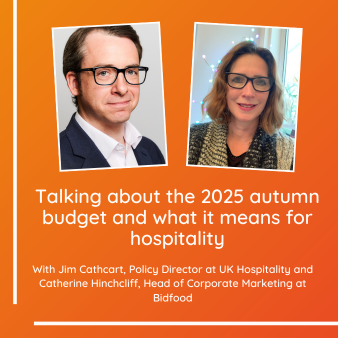
I'm your guest host for this episode, Catherine Hinchcliffe, head of Corporate marketing at Bidfood. And this is a special post budget episode where we're taking a close look at the autumn budget announced on 26 November, and what it means in real terms for hospitality.
And to help us unpack the headlines and what's behind them, I'm joined by Jim Cathcart, Policy Director at UK Hospitality.
They are the leading voice for the hospitality sector, representing more than 750 members now and over 123,000 venues like pubs, hotels, restaurants and coffee shops. And we'll be discussing everything from business rates and VAT to workforce pressures, sustainability and how the industry might respond in the month months ahead.
So whether you're an operator or a supplier or someone passionate about food and hospitality, you'll find this episode is essential in helping you understand the budget and plan and adapt.
So, Jim, welcome and thanks so much for giving your time today to join us at what must be a particularly busy time for you and UK hospitality.
[00:01:31] Speaker A: Thank you, Catherine, and thanks to Bidfood and the team for having me on the podcast today. And yeah, it is busy times, a lot to unpack, as you say. And yeah, looking forward to sharing some thoughts and views from a sector body perspective, which hopefully will be useful for people to help plan ahead as best they can.
[00:01:49] Speaker B: So when it was finally announced, what were your immediate reactions to this year's autumn budget? Any big wins or disappointments for the hospitality sector?
[00:01:58] Speaker A: It's really interesting this, this most recent budget because in terms of, like, immediate reactions, I think what we saw was a lot of this had been announced already. I think unlike any previous budget that, that we've seen, really, or at least, at least that I've seen. The amount of material that was trailed or flown as kites, or however you want to put it beforehand was, was immense. You know, you'd usually expect, you know, maybe the weekend before, you know, a few things come out in the papers, or maybe there's one thing in particular that sort of, sort of teased out in the weeks before, whole raft of policies that were sort of put forward, you know, for the budget, plus the chance for sort of pre budget briefing bit, which is obviously, you know, a lot of questions around, around that in the media at the moment. So the sheer amount of information beforehand meant that when we got to budget day itself and heard the speech, I think a Lot of it was, you know, wasn't, wasn't particularly a surprise and, and we'll come on to things like tourism taxes and those sorts of things later on. But yeah, I think a part of it is a lot of it. So much of it was sort of pre trailed if you like that. A lot of it was okay, there we go, said that, tick it off, move on. But I think in terms of what we did here, and we'll talk about today, things like that level of business rates support, for example, was there going to be anything more for the sector on some of those other core campaigning asks? I think we were, we were sort of waiting to see what was said on that. And I think to sum it up, you know, the immediate reaction, I think once the Chancellor sat down was sort of like really, you know, is that it? I think, you know, and that's even before some of the implications of what we heard last. Last week we saw work through and then that became, you know, a bit more, more emotion came into it at that point, I think for a lot of operators.
[00:03:37] Speaker B: So what parts of it would you say are likely to have the most direct impact on our industry?
[00:03:42] Speaker A: When it was announced, you know, we had on the business rates there was that 5pmentioned and straight away, you know, our big ask was, you know, 20p for, for a number of reasons which we'll get into. So I think that lack of support there is going to have huge impacts around business rates. I would say that's the number one coming out of the most recent budget. I think there are other knock ons as well around minimum wage for example, and the employment piece. But I would say if to pick one that's going to have the most impact and that's where the sort of potential car crash element comes into it than it is around business rates. And I think there was that expectation from the sector. I think all the campaigning that everyone did, all the companies got really behind, you know, the campaign ahead of this budget. Especially after the Nick's piece that we saw last year which really, really had an impact.
People surely thinking, you know, government will leave us alone for this time or at least give us, you know, if not something, then at least not, not whack us with anything. And, and lo and behold the business rates piece came through. So I think that's probably the number one.
[00:04:47] Speaker B: UK hospitality was very proactive in calling for government to take the brakes off hospitality in the run up to the budget. And you had those three kiosks, didn't you? Lowering business rates to revive high streets, fixing the employer, national insurance contributions to boost jobs and cutting VAT to drive investment.
Do you think that those messages were heard? And where would you now say that you stand? How do you plan to move forwards on some of these kiosks now the budget's been announced?
[00:05:20] Speaker A: Yeah, thanks, Katherine. Yeah, I mean, and again, obviously, and thanks for your kind words about being, being proactive and leading those three strands ahead of the budget. Again, I would say, you know, that, you know, the, the strength of the campaign this year wouldn't have been possible without members such as bidfood yourselves and wide range of our members across hospitality getting behind that as well. You know, getting NPs out to pubs, restaurants. And also, I think what was great this year was businesses being willing to sort of share their stories so get in front of, you know, local national media as well, and, and really getting involved. So everyone sort of pulled together, which, you know, from a camp, a campaign perspective, in isolation is fantastic. But, but obviously this gets the key point. You know, all this noise is made, everyone's got involved. You know, media coverage was great, social media coverage, again, really, really good. But, you know, we end up with, you know, frankly, a disastrous budget again for the hospitality sector.
And I think, you know, that question. Do you think, do you think we were heard? I think interesting enough, we as UK hospitality got our name drops by the Chancellor in the speech itself, which interestingly enough, usually only happens if the government think they're doing you a favor, which is interesting itself. We'll come back to that a bit later around the business rates piece. But it's a really interesting one, isn't it? Because clearly, you know, they heard it, they saw it again, we put the job statement in front of them, you know, the job losses from, from the next piece. But, but what we're trying to want, you know, what in the post budget analysis trying to untangle is, you know, did, did they hear us and go, do you know what?
There are bigger fish to fry for us elsewhere, we're not going to do anything for them. Or did they hear us and think genuinely that, oh, well, we're helping you out here because we've given you 5p off rates without looking at the wider picture.
Or is it genuinely a view that like, you know, we favored certain types of business on our list to be that financial tech and AI and that sort of thing, and everyone else, you know, sort of, you know, sorry, sorry, chaps, nothing for you. You know, it's, that's what we've got to look to.
[00:07:22] Speaker B: So you think maybe it's a question of not whether or not you were heard, but whether or not the government truly appreciates the worth of the hospitality industry.
[00:07:30] Speaker A: Sure, sure. I think it's that. And, and that's where you get into if you're looking at sectors from a purely hard nosed product metric, you know, you know, on those numbers, hospitality doesn't stack up on that metric versus you know, some of those other sectors I mentioned, you know, those high tech type ones or, or financial services.
[00:07:48] Speaker B: But that's why you created the social productivity indeed, isn't it?
[00:07:51] Speaker A: Yeah, it is indeed exactly that. So that's why, you know, have as many strings to our bow as possible. That's why we created that measure of productivity. It wasn't just about numbers on the treasury spreadsheet. It was okay, how, you know, here's how productive we are at getting, you know, young people into work tick. One of the most productive sectors, if not the most, you know, gender diversity, all these different things, you know, to do with, you know, how socially productive we are and trying to put that into a numbers framework which we all know working in hospitality. But how do you actually get that across? And I think that is something we're going to enhance and move forward with ahead of, ahead of next year because it's that social value piece and again that is working out. How then do we get government to look at that? If they've looked at it from a purely numbers point of view and gone, okay, you don't stack up compared to these other sectors, fine, we need to look at the social element to it as well and try and link them into that.
[00:08:49] Speaker B: And that must be a compelling argument for a Labour government.
[00:08:53] Speaker A: You don't say, you don't say, Catherine. And I think it will be. And I think the one which I think we will be good to land is the, there's the social productivity piece, but there's also this community pride in place high street piece because before they came in labor government said one of the metrics to measure them by the time of the next election in 2029 is, was basically does my high street feel better or worse than it did at the start of this parliament? And I think that's one where I think we can do some more work to really get them focusing on, to sort of say to them, look, with these fiscal policies, you aren't doing that. And people are going to look around a few years time and go, my high street and hospitality businesses and other businesses on it are either not there or, you know, underinvested or whatever it might be. Why don't you as government get ahead of that, you know, given that was one of the metrics that you talked about and start supporting these businesses? So I think it's that being. And then being able to link that to the fiscal by saying, look, when you, when you do these things like sticking on business rates or employer NICs or whatever, you are hitting the businesses and the workers in those businesses more so than you are some of those other sectors. And it's basically socially regressive policy. So it's playing into that argument.
[00:10:15] Speaker B: I think the other thing that real people will feel as an impact, ongoing inflation and food cost challenges.
Do you think the budget provided any meaningful support to businesses to manage rising input costs and keep prices sensible?
[00:10:32] Speaker A: I don't, I don't think it did in particular, I think again, only can you really speak for hospitality. But when you've got that fixed cost, which is business rates going up, as it looks like for most people it will, then that automatically eats into your ability to your purchasing power and your ability to invest and grow and all those different things and we'll come on to it. But with the business rates piece in particular, that's a fixed cost. With other challenges, even our workforce and certain things, our businesses are super versatile, super adaptive and you're able to move things around if you want to deal with those challenges. But when you've got something like your business rates bill, just like, boom, that's gone up by X, that's fixed costs that you can't avoid, really. And that's money that's coming out of other things.
[00:11:25] Speaker B: Well, that actually is the next thing I was going to talk about.
And the budget delivered lower business rates for retail, hospitality and leisure. But the discount that was the key thing was only 5 pence compared to the 20 pence you were asking for.
Do you believe that that level, that lower level, was sufficient given some of the big increases in rateable value that some sites will see on. For example, we've been talking about the high street alongside the increase in wages and all the other operational costs and inflation that hospitality businesses have to navigate?
[00:12:02] Speaker A: Yeah, I think no is the short answer to that 5p. Is that enough? No, it's not.
And as we talked about, one of our core campaigning asks ahead of this budget was that 20p, which is the max. By law, the government can give and give us the max. Now, we were calling for the max for a number of reasons. It wasn't just give us the Max, because we want the max and there's nothing sitting behind it. That was a conscious call and that was for one particular reason, which was.
And again, we're getting into business race territory here now, which is intensely complex and dull at the same time. It's a double whammy. But important. But in essence, what's happened this time round is you're not applying that 5p to the business rates bill that you got this year. For example, every three years everyone's business rates value, if you like, will be looked at and adjusted. So there's a three year adjustment. So with a bit of lag in it, which has caused a problem. So they'll look at. So that basically that's to keep it in real time. So unlike your counter tax, which is obviously your domestic version of business rates, which has been at the same value since early 90s, I think in business, business rates world, it's looked at every three years to, you know, to try and keep it, you know, accurate, which makes, which makes sense, I guess. Problem is, the most recent council tax business rates bills would were calculated for Covid times, so 2021, so they were lower but obviously move through Covid so the bills kicking in for next year will be valued in post Covid times. So as you would expect, that's jumped up because basically no one was trading at the time of the last business tax bill. And because it's linked to your, you know, you're basically your trading for most people, your bill have gone up. So you weren't getting 5p off your current bill, you're getting 5p off a much bigger bill in most cases.
So where the government was saying, don't worry hospitality, we've got you back, we're giving you 5p off your bill and you'll be paying lower rates. It's like, no, I'll be paying much higher rates. So basically my rates have jumped up. And we said this beforehand and we said, look, look, that's why you've got to give that 20p to mitigate this big jump that's happening. Government. Yes, yes, yes, we put the word through. But what's happened is, and I think whether it's a lack of understanding or whatever, in the budget speech, they sort of trumpeted this 5p and said, UK hospitality and British Retail Consortium have done a great job and you know, we're going to help you out, we can knock your 5p off without potentially fully realizing that, oh, actually everyone's bills are going to jump up. So straight after people would be like, well, you said, you just said you're going to release our business rates bill, but it's gone up massively.
[00:14:55] Speaker B: So there's that doubled, in some cases tripled.
[00:14:58] Speaker A: At least, at least. And so there's that, that factual piece which is everyone bills has gone up even though the government said, we're going to help you out. Number one, the second piece to that is the amount they've gone up. So some analysis we've done very quickly after the budget has shown that for hospitality businesses, pubs, hotels, restaurants, the percentage for those sectors that their total bills have gone up much, much higher than, for example, Amazon Warehouses or insert your online giant here, Warehouses, you know, so we took it up by much lower amount.
So where government have been talking about business rates support the high street, you know, bricks and mortar businesses, you know, we're going to support you.
Actually, what's ended up happening is they're worse off than some of these other sectors that they said they want to try and rebalance it against. So it's a bit of a mess, Catherine. It's a bit of a mess is what's happened.
[00:15:48] Speaker B: Do you think the position's recoverable with another campaign with more noise from the sector?
[00:15:54] Speaker A: So I think there's always a chance with these things. I think the stage we're in now, in the, in the weeks around, immediately around the budget, it's about discussion, negotiation, seeing where we can get to here to see if we can secure, I don't know, a pushback in the revaluation piece or an increase in that 5p race rate. That's all, that's all up for grabs. Because I think the position is clear, it's fundamentally unfair and I think that's what we're going. Well, that's what we are going in on. Like, look, you've, you've said you're going to support hospitality and small businesses and others here with the rates piece, and you've done the opposite. That's, that's factual. And not any of you done that. You've, you've hit us harder than you have done these other sides of business, which you said you weren't going to do. So that's the double. So please, can we, can we sort this out? I think, you know, depending on how successful that is, I think absolutely a campaign has to be had. I think the, the amount of, you know, righteous anger out there in a moment in hospitality world, because this is, this is fundamentally unfair. You know, we, we should tap into that and we should make a case and whether that develops into some campaigning piece, you know, or whatever that might look like. You know, I think we have to, we have to because, you know, potentially the impact on the sector are so big that if we don't fight it out again, we're in, you know, we're in potentially big trouble.
[00:17:14] Speaker B: So if you're listening to this episode, please keep a close eye on what UK hospitality are doing on that front and support where you can. Yeah, the other key issue, the budget didn't include any reduction in VAT for hospitality. Another reviewer asks, and repeated calls for it. How damaging is that the industry.
[00:17:33] Speaker A: We're doing terribly on these asks here, aren't we? We're doing terribly against it. But I think with the VAT piece, that's an interesting one. It's like, you know, in, in our mind, look, if, if there's one thing to do to increase, you know, growth, a term which seems to have fallen out of favor with government, interestingly enough, if you want to increase growth and, and get things moving, if there's one thing you could do for the hospitality sector, always the answer would be reduce VAT. You know, you look at the EU average, you know, it's 12% people are paying in the EU for VAT on out of home food, for want of a better word, we're way out there with, with 20% as an outlier.
And it's one where it's a really interesting one because we make the case pretty much every budget and have done for years, rightly so. And even with our members, you'll get a view that with some businesses it's like this should be your core ask, you know, you should only be asking vat. Is that totemic? You know, and there's, there's, you know, there's, you know, totally get it because it would be a big thing. And interesting enough, there'll be other businesses who are like, why are you bothering with vat? It's never going to happen. It's much better to be focusing on business rates or Enix or whatever it might be. So there's always this view, you know, between it and I think we, we keep it firmly on the table because in the mind of government, which has a very short term memory, often if you're not calling for something, they basically forget about it or they think, oh, the sector don't think that's an important anymore because they're not calling for it. So in order to keep it, you know, on the shelf as an issue, you have to keep talking about it. So that's why we do it. And then the second piece is, you know, at some point in the fiscal climate might be in a position where, you know, they will, you know, it will be actively looked at but they won't if, if we've sort of, you know, taken it off the, the main, the main options deck, basically. So that's sort of the piece on vat. So. And I think, you know, realistic when finances are, you know, where they are. I mean it would have been great to have got VAT cut and it's always possible but I think with that one it's, that's a long term one or at least a medium term one that we keep pushing on, I think.
[00:19:35] Speaker B: And then the last topic was national living wage and employer national insurance contributions which all add up to large added wage burdens. And we did see some increases in national living wage for younger workers and the removal of national insurance relief on salary sacrifice contributions over £2,000. So what immediate risks do you think that poses for staffing levels, opening hours, prices for consumers?
[00:20:06] Speaker A: Yeah, I think it's a big one, isn't it? And I think this is always. Well, no, this is going back to last year's budget, so 2024 budget with that increase in the threshold for employers national insurance, where in essence it makes it more expensive for employers to hire people on lower wages is what it did. So we saw some immediate reactions after the last budget which was in essence businesses making adjustments around not hiring new staff or you know, looking at, looking at the team and having to make decisions there. And what it ended up with was, you know, 80, 90,000, basically job losses in hospitality between 2024 and, and up till now pretty much as a direct result of that because basically too expensive to hire new staff, who in many cases that's young people, that's their first job and forcing employers rather than, as we did do, take a chance on somebody or get a young person in who then can rise through the ranks.
Fiscally all you can do is either stick with who you've got or look around for a more experienced person because weirdly it's incentivizing you to do that rather than hire, you know, 17, 18 year olds, which again is, is a bit crazy given the government's day and aim of getting young people into work. But that's a practical effect of it. And I think with the national living minimum wage piece that we saw, I think obviously as a sector we want to pay people well and we do, and there's no question about that, there's the move by government to sort of harmonize the different rates of national minimum wage with the living wage, which again, in principle, you know, we support.
But I guess it's around the speed that you're doing that. So again, we saw some, some significant sort of hikes in that lower rate this time around.
But you know, whether that, you know, that that sort of jump system can be sort of smoothed across a bit till we get to the point where we want to be. Because this is not an isolation. It is alongside all these other pieces, you know, it's the minimum wage or living wage piece going up alongside your business rates, going up alongside your employer, national insurance going up alongside your food and other input costs going up. It's, you know, in what is a low margin sector anyway, it's, it's pretty tough. It's pretty tough. But on that employment piece, I think, and that skills piece, we're doing a lot of work at the moment around the skills passport and promoting what the sector can offer in terms of, of careers and skills and that sort of thing because we think it's vital. And going back to your point earlier, Catherine, around the social productivity index, this is where as a sector we can help society out, if you like, by getting people into, into their first jobs and into work and into, you know, flexible work that fits around, you know, caring responsibilities, whatever it might be.
And we're in every part of the country. We're not focused in, you know, some, some tech triangle somewhere. You know, we're in every, every high street town, you know, city. And it's like, you know, that we feel, and I think most people would feel that that is worth something societally and that's what we've got to get the government thinking about.
[00:23:07] Speaker B: Alleviating the pressure. Yeah, it's not all doom and gloom, I guess there are some chinks of height.
Let's just head for a few quick fire questions on some of those. Actually, the budget did mention new red tape reform. Will that help small to medium sized hospitality operators or large ones?
[00:23:29] Speaker A: It will, it will, I'm pleased to say, Catherine, it will. So yeah, and I think rightly focus has been on the big hits, because they are big hits and rightly we're focused on them. Rightly they're causing anxiety across the sector and you know, we'll act on that and hopefully get some movement on it. But as you say, there, there were some other elements in the budget things we've been working on for a while in terms of, you know, red tape and you Know, every government comes in and says, we're going to cut red tape, we're going to have a bonfire regulation, we're going to, you know, free up businesses. None of them do it. None of them do it. It's, it's the opposite.
And with this government, they made a commitment. Yeah, we're going to cut 25% of red tape for businesses. Okay, here we go again. Fine. But interestingly enough, interesting enough early this year with the licensing system in England and Wales, that exciting subject, but again, another vital one. So that's basically your permission to trade if you're, if you're selling any sort of alcohol or you're a late night business or, or hotel with, with that offer. And it's much wider than just can I sell booze? Yes or no. It's the whole system around it. In essence, it's can I open a operate hospitality business, all sorts of permissions there. That system's been in place for 20 years.
Over the years it's, you know, what started off with the intention of being, you know, light touch regime, good for businesses, good for residents. As often with these things it's sort of become clogged up, if you like, with, you know, requirements for businesses that don't really need to be there. In our view, you'll have areas that will look at licensing as a bad thing and try and restrict the number of premises because, you know, They've still got 1990s binge drinking headlines in their mind or whatever it might be. So actually makes it really harder zealousness. Yeah, gold plating, whatever you want to call it, it's all of that.
So we have been saying for a few years to government like the time is right to scrape some of these barnacles off the licensing chip or whatever and, and free it up and it'll help growth and all the rest of it. And to be fair, this government said, yeah, right, we'll give that a go. And there was a task force formed earlier this year which we were part of alongside other stakeholders and the police and so on. Had a look at the regime. Very short amount of time to make some recommendations in terms of how to free it up. Government took a look at it and went, yeah, that sounds good. Okay. So interesting enough, one of these sort of red tape reform things that actually has actually happened, which is a rare thing, a rare thing for government to reduce regulation.
So that was actually really positive and that will have real poundside impact for operators. So things like hopefully where at the moment you have to pay Fees to local newspapers to basically advertise the fact you're going to open a restaurant or whatever, they'll be scrapped. Hopefully.
Things like more opportunities to use outdoor areas at lower cost, more, more freedom to open in areas, more direction to local authorities to say, look, these are good things for your high street. Encourage more of them, don't try and stop them opening, which again, sound a bit intangible. How do you put a value on that? But if it, but if it's right, you know, potentially you could see some real freeing up of, of high street and, and other areas or space for, for new hospitality development. So, weirdly, that was a positive. And a final piece on this regulation point announced in the budget, they're looking to do the same for the planning system as well. So again, looking at that, the delays in trying to get either a new site, but often just an extension or kitchen alterations, whatever it might be, having to take years to do it, and massive costs, they're looking at cutting through some of that as well. So if we take it in the spirit of positiveness and partnership, that's something that, that we'd be looking to take forward to free, free up some of these regimes for businesses.
[00:27:19] Speaker B: So, holiday tax, what were your thoughts on holiday tax after receiving a confirmation of a bit of a turnaround that they were planning to introduce that when I think before the government have said that they didn't have plans on that front.
[00:27:33] Speaker A: Yeah, this one was really like, this is quite a bit of a gut punch, to be honest. This one was like, oh, you're not. Because, you know, for a number of reasons, a, we don't think they're. They're good, unsurprisingly, but for good reason. And yeah, so, okay, there's one in Scotland, there's one coming in Wales for England, you know, written to the government early this year, say, please don't bring it in for these reasons. And they're like, yeah, we've got no plans to do it. Did that twice.
[00:28:02] Speaker B: Twice.
[00:28:03] Speaker A: Yeah, I got an answer from Parliament, you know, nary two months before the budget for them to say, yeah, we still got no plans.
And then in one of those sort of many leaks before the budget, it was, oh, yeah, we are going to do one after all. It's like, really, come on, come on. Not with all this other stuff. So pretty annoyed, pretty annoyed on this front as our members, because it's really annoying. It's like, you know, why are you bringing this in? Well, because, you know, Berlin's got one and Amsterdam's got one and you know, British always have those. It's like, well, but all those other places, you know, again the, the amount of tax that those businesses are paying there on VAT or whatever, 12%, you know, is much, much less. You're not comparing two things across the piece here. And you know, it's just that argument of what X has got it so we should have it too. It's like that's really poor, that's really poor. So there's a lot of annoyance around that. Also the practical implications Scotland that's, that hasn't even come in yet in Edinburgh and that's been, you know, however many years in the making now because of the practical issues it ran into, the legal issues, you know, all the rest of it.
So it's just, you know, it's just a grind and government will say, well it's down to local mayors to decide whether to introduce it or not. The other question is where does that money go? You know, is a ring fence to actually improve the tourism hospitality offer? Does it just go into, you know, fixing potholes in, in wherever, you know, it's, you know, it's, it's, it's not a good way of doing things in our view. So that was one where we're really annoyed about I think not, obviously not to the same extent as business rates and those top level fundamental piece is. But pretty close to be honest, pretty close. And there's consultation open now to mid February and we in industry will be making our views known on yet another tax.
[00:29:46] Speaker B: The project also included signals around mandatory reporting on healthy food.
What do you think operators need to know and prepare for on that front?
[00:29:56] Speaker A: As we know the, the government have got a food strategy and they've got a 10 year health strategy. Obviously governments do, do you love strategies? And as part of, well, part of both really, they've committed to introducing mandatory food reporting for large food businesses by the end of the Parliament 2029. Now that is one where, you know, discussions ongoing around what is that going to look like. And I think it's one where, you know, in this whole arena of government intervention around sort of healthy food obesity, we had, yeah, voluntary reporting schemes then we had more recently mandatory interventions around calorie labeling on menus and then you know, ban on serving hot refillable hot chocolates and advertising bans and these sorts of things. It's, it feels quite unfocused from governments. You know, it's very much like, you know, just this sounds good, let's throw a bit of Regulation out there without tracking. Hang on, is this doing anything to obesity rates? Is this doing anything to consumer behavior? There's no real like measurement of this stuff. So it's, it's, you know, it's been, it's been very fragmenting and patchwork, to be honest. And that's. But on this, on this data reporting piece, I think it's quite interesting because previous governments started some work in this field and again, as a hospitality sector, we're like, yeah, let's, let's talk about it, let's make sure it works for us. Because I think when it comes to these reporting things for hospitality, the issue comes where government or whoever's setting the rules just assumes, well, hospitality is just a straight read across from retail or production. No, it's not, it's much more complicated than that, as we all know. So I think with the mandatory reporting piece, you know, government are committed to it. So as far as, you know, it's coming.
So for us it's about getting it right for hospitality sector, if it is coming in, in terms of what's reported, how, you know, flexibility, you know, to get some actual meaningful that everyone can use, hopefully helpfully out of it is the way forward. So I think for that one, I think for. We'll see what large means in this context. But for larger businesses, I think, you know, to have it on the radar early days on it, I think, but, you know, we'll be pushing to make sure whatever, whatever comes out of it actually is practical and works and hopefully is actually useful for, for the sector. And we avoid some of the sort of unevidenced policy making and interventions that we've seen on this front.
[00:32:25] Speaker B: So that's a case of keeping a watching brief.
[00:32:29] Speaker A: Yeah, exactly that.
[00:32:31] Speaker B: What did you think the budget missed? What's needed to alleviate all this pressure and future proof hospitality growth, restore confidence, really, in the sector.
[00:32:41] Speaker A: Yeah, thanks, Catherine. I think the answer's in the question now, which is it was missing, you know, a real mention of growth, let alone solutions, fiscal solutions or levers or whatever you want to call it to drive it. So I think it missed the point that ahead of the 2024 budget, hospitality was one of the fastest growing sectors and obviously all of that will feed into wider UK growth. And I think it missed the ability to get us back on track with that and I think recognizing that businesses can only absorb so much or should have to absorb so much until it starts having an impact on, you know, workforce or even viability, and I think it's missed the fact that fiscally, if you sort of help us out here, we can deliver so much more on your other programs. And that's going back to the social elements that we talked about earlier. That means, you know, better, happier, healthier, more vibrant high streets. You know, that means more young people into work, getting those experiences, you know, potentially some of them making careers in the sector, you know, again, more growth. You know, that positivity there, you're missing out on all of that. And by focusing on some of these other sectors, you know, you're forgetting that all these sectors, you know, they have a foundation beneath them. You know, people like to, you know, go out, eat, drink, whatever, be as part of their work life or part of their, you know, private life. And you're losing that if you can with these sorts of policies. So just no recognition of that really whatsoever.
[00:34:17] Speaker B: People go out to celebrate, treat themselves.
[00:34:19] Speaker A: Yeah.
[00:34:20] Speaker B: Make themselves happy, and then you have a happier society as well.
[00:34:23] Speaker A: Correct, correct. You know, that's, that's the thing here. And I think, and if you, you know, if you, if you're going on anti that with your policies, then it's, it's pretty, you know, socially regressive. And yeah, if you're impacting the ability for, for people, you know, to access sort of low pay, flexible jobs as well, that's creating a big problem, you know, on, you know, socially and, and everything else. So I think it's just, I think there's a view from, you know, this government and potentially previous governments, the hospitality, you know, they'll always just get on with it, you know, and, you know, props to the sector because we're super, you know, supremely resilient, but everyone can't be resilient forever. There comes a point, you know, where it is too much, and I think we're at that. And there needs to be that recognition of, you know, the social benefits that we bring, both on the jobs front and the fiscal front and the place making front and all those different things. But as right as you say, Catherine, you know, also helps people have fun. You know, people like going out, people like socializing with other people, you know, and that's the thing that should be celebrated rather than tax out.
[00:35:24] Speaker B: Well, I know I have much more fun going out for a nice meal than having an Amazon delivery.
[00:35:30] Speaker A: Absolutely, absolutely.
[00:35:32] Speaker B: What practical, what three practical things would you advise hospitality businesses to do in the light of the last budget then? Okay, so how should that translate into their plans in 2026?
[00:35:45] Speaker A: Okay, so the immediate piece is keep an eye on what's going on with UK hospitality trade press, however you get your info in terms of the business rates piece. Okay, so how could, you know, how can I challenge my rates? How can I help the industry campaign to rebalance what, what damage was done the other week? So business rates, keep an eye on the trade news, keep an eye on the channels that you get to get involved in the campaigns because this one where we've got to be united on and give it a good old push. So that's my immediate one following the big hit in the budget, I think in, in the medium term again there's cost pressures around employment coming in and you know, I'm not going to sit here and tell operators how to, to do things because you know, they, they, they know how to do this and when it comes to costs and so on. But again it's just that general just you know, cost to get up next April's, you know, potentially a big, big jump in terms of business rates in terms of national living wage. Make sure you've gold iron hand however you're managing that but people know how to do that I guess. And then the longer term piece is get involved with the, the industry sort of campaigning around this social value of the sector piece. So we started, we started this year with the social Productivity Activity Index just starting to feel out again alongside the more I guess traditional lobbying around fiscal piece. But I think that that social piece and that you know, what hospitality can bring over and above some of these, you know, some of these other things the government are looking at and how it complains. The agenda is going to be big next year. So, so again, keep an eye out for that and hopefully when you are, you and I, Catherine, are talking next year, it won't be a repeat of this conversation. Fingers crossed.
[00:37:30] Speaker B: Let's hope not. So that brings us to the end of this episode of Talking Food. A huge thank you to Jim Cathcart for sharing his perspective and expertise.
[00:37:39] Speaker A: It's been a pleasure, Catherine. Thank you guys so much.
[00:37:42] Speaker B: It's clear that the autumn budget presents some big challenges for our sector, although there are still some steps in the right direction, one or two small ones and windows of opportunity to go for in what is currently a very tricky market. But then, as we said earlier, hospitality is nothing if not resilient.
At bidfood, we'll be keeping a close eye on how policy continues to evolve and do our part to support operators and partners across the sector.
If you found today's discussion helpful, don't forget to subscribe to Talking food on your favourite podcast platform and share this episode with your colleagues. And don't forget to keep a close eye on UK Hospitality's website too. You can also find more resources, food trends and practical tools tools to support your
[email protected] UK and via our LinkedIn and Instagram channels. Thank you so much for listening and we'll see you next time.