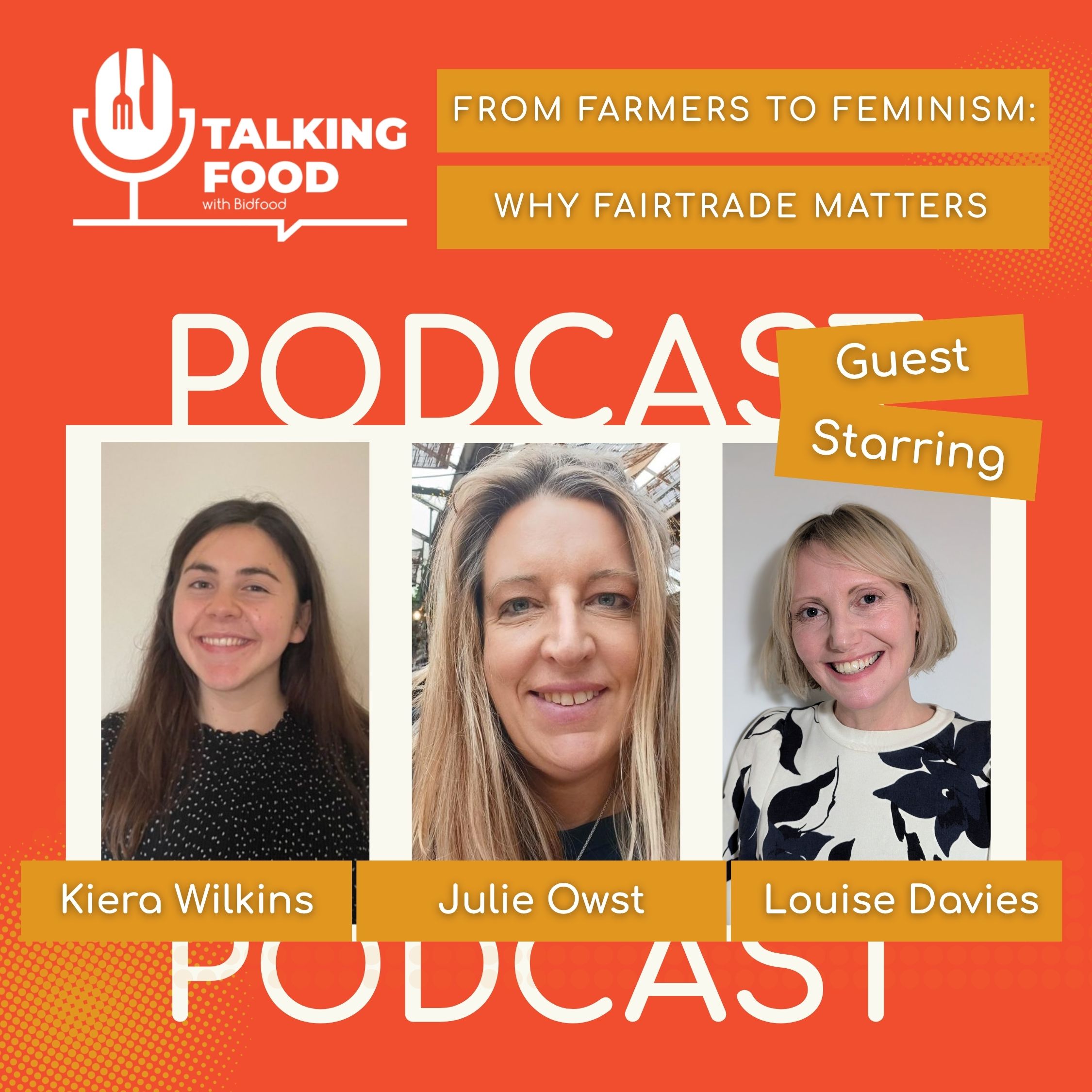
[00:00:03] Speaker A: Hello and welcome to the Talking Food With Bidfood podcast. I'm Julie, head of sustainability at Bidfood and your host for today.
In this episode, we'll be discussing what the Fair Trade logo means for our customers, for their customers, for the workers producing your food and the land they're managing, with specific reference to the climate crisis. I've been really looking forward to this podcast. I work in sustainability and it's just such a lovely change to talk about the people producing our food. It's so much more interesting than carbo emissions and we hope you are going to enjoy learning more about this.
Welcome to the podcast, Louise and Kira. Louise, could you please introduce yourself and tell us a bit about your role and what Scottish Fair Trade does?
[00:00:48] Speaker B: Hi, Julie. Thanks so much for having us here on your podcast. We're delighted to be involved. I'm Louise. I'm the chief Executive at Scottish Fair Trade and we're a membership organization that brings together all parts of Scottish society to campaign for fair and sustainable trade.
We were set up almost 20 years ago by some passionate campaigners and a few NGOs, so people like Oxfam and Christian Aid and Ski F. And really part of what we wanted to achieve back in those days was to get Scotland to become a fair trade nation. So that really means that there's evidence, there's an independent assessment to say that Scotland as a nation supports fair trade. So I'm delighted to say we got that achievement back in 2013 and we've retained it since. We just had a renewal last year. So we know that Scotland is very passionate about fair trade.
[00:01:35] Speaker A: That is awesome to hear and it sounds like you have a great job. And Kira, thank you very much. If you could just introduce yourself.
[00:01:42] Speaker C: Yeah, thanks, Tui. Hi, I'm Kira, the Ethical Business Manager here at Scottish Fair Trade. A lot of my role involves supporting businesses across the country to strengthen their ethical commitments. And more broadly, it's also about trying to increase the production and consumption of fair trade goods.
I think a key part of this work is promoting the 10 principles of fair Trade.
These principles set out very practical standards for businesses, so covering issues that you might expect, like fair payment and the elimination of forced labor, but also areas like gender equity and climate justice as well. So those principles are closely linked to the UN Sustainable Development Goals, and they just provide a really strong foundation for businesses across the UK and the rest of the world that are looking to take a more ethical and responsible approach to trade.
[00:02:33] Speaker A: Fantastic. Thank you. Some really good introductions there.
So, for the benefit of our listeners. The three of us had a teams chat a while back about Bidfood's sale of Fair Trade products. And we were all so passionate about what the Fair Trade logo means that we decided to do a podcast on it there and then. We all feel that it's largely misunderstood or underestimated. Despite there being so much positivity around the logo, at Bidfood, we've got a vision to be a positive force for change in the world of food service.
So this does bring us to today's conversation. So, Louise, to help us understand the concept of Fair trade, could you just briefly explain what's unfair about the majority of world trade? In other words, what's the problem that fair trade is trying to address?
[00:03:13] Speaker B: Yes, sure. So we know there are lots of structural imbalances in global trade as it stands, and fair trade is responding to that. So with agricultural commodities, which is really what we're talking about, so we're talking about the Fair Trade logo. So things like coffee, cocoa and sugar, they're subject to highly volatile global prices. So often those prices fall below what is a sustainable production amount for farmers. So it means that they're not earning a living income.
And then we also see an imbalance of power across the supply chain. So buyers have the influence and the power, and there's an unequal sharing of the risk level and an uneven distribution of value. So it means that farmers are carrying the risks.
So their risks are price shocks or climate impacts, and they're also receiving the smallest share of the value.
And within the climate crisis, I know you mentioned, that's something we want to talk about that's clearly affecting yields and livelihoods and long term sustainability. So it's a really challenging space for farmers. And Fair Trade tries to address those inherent imbalances by offering the minimum price. So that means that there's a safety net. So when markets crash, farmers are always paid a minimum amount. And also the Fair trade premium, which is a really important part of Fair trade certification, because that's an extra amount of money that goes into the communities, so farmers and producers can invest in whatever they like. So that could be things that benefit their community, or more and more, we're seeing it being used for initiatives that support climate resilience.
[00:04:44] Speaker A: So thanks, Louise. And listening to you, it just does strike me how much risk is part of farming. And it seems inseparable. And that risk is growing with the climate crisis and the unpredictability of harvest. So thank you for raising that. And when it comes to the price Fair trade almost always necessitates the consumer paying an additional premium. What would you say to people in a cost of living crisis that say, food is expensive enough when eating out, we just can't afford to pay extra, and that people wouldn't produce, for example, coffee if they couldn't make a living from it?
[00:05:17] Speaker B: Yeah, I mean, that is a really important question. Firstly, the additional cost of choosing fair trade at the consumer level is usually quite small, and particularly at somewhere like the Co Op, if you buy tea or coffee, it's all fair trade anyway, so that takes it out of your choice, which is in some ways the way we'd like to see things, but in many cases a marginal difference, especially in a food service setting. But we're seeing a shift in consumer expectations and people do increasingly care about where their food comes from and also what conditions it was produced under. So we are seeing a growing demand for transparency and some assurance that the workers were actually treated fairly.
And it's a fair point about the idea that farmers wouldn't be producing it unless they were able to. But often farmers are locked into these systems where they just don't have any other options.
There are a few viable alternatives and they just don't have alternative income streams. So even when the prices are unsustainably low, there's very little option that they can have. Often these farmers have been in that space for years and years and it's very hard to shift into something else.
[00:06:20] Speaker A: Thanks, Louise. I think that really explains the issue well. And I think the social angle of sustainability is often overlooked in favour of environmental concerns. When our customers are buying food, there's so much talk, for example, about net zero commitments and switching to lower carbon diets that the producers are overlooked when actually food production is about a partnership between land and people. And we often forget that link. Obviously, it's all important. You don't get one without the other. And while we will return to the social angle in a minute, can I just ask, what does fair trade mean in environmental terms?
[00:06:56] Speaker C: Yeah, I think in terms of the environment, fair trade includes very clear environmental standards, so it includes requirements around sustainable land management and it restricts harmful practices as well. I think we touched upon earlier. But the fair trade premium gives cooperatives the resources to invest in climate resilience. So things like soil health, water management, crop diversification and kind of adaptation strategies as well. And I think for businesses in the UK this is increasingly relevant since climate risk in supply chains is also a business risk.
So investing in more resilient production systems isn't just the right thing to do in our eyes, obviously, but it is also part of long term supply security.
And I think if we take something like coffee as an example, Marichi farmers cooperative in Kenya was finding that their coffee was becoming increasingly affected by kind of new emerging pests and diseases. They saw declining yields and kind of suffered from extreme weather events as well as. So as part of the climate Adaptation Plan, which is part of the Fair trade coffee standard, developed a plan that identified kind of major risks and strategies to address them. So in their case, soil erosion was identified as a major threat and farmers were really encouraged and trained to adopt kind of mulching, cover cropping, planting shade trees, things like that, and switching to more resilient coffee varieties as well.
And as an additional point, I think it's important to note that net zero transitions that ignore producer livelihoods risk shifting the burden of environmental action onto those who are already most vulnerable. So we know that communities on the front line of climate change are often those least responsible for it.
[00:08:47] Speaker A: Thanks, Kira. Such good points there. And I think the point about climate resilience is so important Bucks a relatively unknown aspect of the fair trade scheme. And if we go back to the social element there, as females, I'm sure we're all keen on initiatives that support women. And in food production, women often work the hardest for the smallest share of the reward. I learned just yesterday on a call about beans that over a third of women globally are involved in food production, so they shoulder the most of the burden of the issues.
Would you go as far to say that fair trade is also a feminist issue?
[00:09:23] Speaker C: Yeah, absolutely, very much so. And I think, as I mentioned, gender equity is one of the core principles of fair trade. So as you say, women make up such a large proportion of the agricultural workforce, but there are often barriers around land ownership, income control, and also participation in decision making.
So we see fair trade standards require democratic governance within producer organizations and they create formal spaces for women's participation. So, for example, in some cooperatives, Fair trade has supported women to take on leadership roles for the first time. Or, you know, it's enabled access to training and resources that might have been previously out of reach. And I think just lastly, touching on the fair trade premium, the funds here are relevant again because they are so often used for things like education, childcare, again, women's leadership programs that we know are so important when it comes to helping shift power and opportunity over time.
[00:10:26] Speaker A: Thanks, Kira. I love what you said about democratic governance and the shifting of power. It's Something we've so needed these days. So the Fair Trade logo has been around for a while, most commonly on coffee, tea, bananas, et cetera. Do you think it still resonates with consumers, given that there are so many different certifications and claims relating to responsible sourcing?
[00:10:47] Speaker B: Yeah, I do think it still resonates and we've got some evidence that backs that up, thankfully. So as part of our research and having to prove that Scotland's a fair trade nation, we commissioned a survey and found that 97% of people are aware of fair trade, which is a really significant figure, particularly, as you say, in such a crowded landscape of different ethical claims. And we also do see a strong engagement from young people. So many learn about fair trade at school and it gives the mark a kind of cultural longevity.
People think about it not just about a label on a product, but something they really learned about at school and was embedded in the values that they were introduced to growing up.
But, yeah, it's definitely. You're definitely right in that there's lots of different certifications and sourcing claims. And we're not necessarily saying that the others aren't good. You know, there's loads of great, great certifications out there that are all doing different things, that fair trade is one of the oldest and most established and trusted and that history carries weight. And for a lot of people, the Fair Trade mark means it's not just about responsible sourcing, but a real focus on producer power and fairness in trade. So fair trade really still cuts through because people understand what it stands for.
[00:11:54] Speaker A: Thanks, Louise. I think you've both done a really good job of illustrating the benefits to fair trade from both people and planet perspectives. There's just a really human side to fair trade, as you've said, which is great.
And just my last serious question.
I hear and see a lot of discourse questioning the rigour of fair trade and what kind of workers it covers and. Or how companies have to operate to be able to classify their products as fair trade. Could you just do some myth busting around these issues?
[00:12:23] Speaker C: Yeah, and I think a lot of that does come down to misunderstandings about what fair trade is and what it is not. So, firstly, I think it's important to understand what the fair trademark actually certifies.
So while the broader fair trade movement encourages business to apply fair trade principles across all their operations, the fair trademark certifies a specific supply chain. So it focuses, as Louise mentioned, on commodities like coffee, cocoa, bananas. These are sectors where global power imbalances are particularly acute and where we know, smallholder farmers and agricultural workers are often exposed to really volatile markets, low bargaining power and really quite entrenched inequality.
So I suppose our message is fair trade operates within a global trading system that is inherently unequal. It's not designed as a perfect solution to this system, but rather it's a practical mechanism that works at scale to improve conditions for farmers and workers within it. And I think another common misconception that I've come across a fair bit relates to the fair trade minimum price.
So some companies claim they pay kind of quote above the fair trade price as a way of suggesting that they exceed fair trade standards. But I think in reality this can be a bit misleading given that the fair trade minimum price is designed as a safety net that protects farmers when global market prices collapse. So in functioning markets, buyers should be paying above this level.
And I think one of the most significant elements of the system, the fair trade premium, which we've mentioned previously, this is an additional fixed payment that goes directly to farm organizations or worker committees to invest in various social, economic, environmental improvements. And those funds are democratically managed by producers themselves.
So we saw in 2023, for example, fair trade producers generated over £183 million in fair trade premium. So as I mentioned, supporting initiatives around education, healthcare, climate resilience, etc. And I think finally, fair trade standards are backed by a robust independent auditing system.
So certification and compliance are verified by third party auditors who regularly assess producers, traders, companies against fair trade's kind of various criteria. So this includes requirements and labor conditions, democratic organizations and kind of transparency in the supply chain. But I think importantly for us, ultimately the impact of fair trade depends on continued participation in the system. So when companies choose to source on fair trade terms, that's when they can help generate tangible financial returns and greater stability for farming communities who are often those most vulnerable. As we've discussed so importantly, I suppose our key message is we're not saying that fair trade alone is can fix the unfair global trading system, but it is one of the most established and credible tools that we have for shifting that value and power in global supply chains. But that only works when businesses and consumers actively choose to support it.
[00:15:37] Speaker A: Thanks Kira. That's a really good point and I've personally always been really keen to look out for the fair trade logo. I think from a young age, my mum always a big fan of fair trade and I think she's passed that successfully on to me. So thanks very much for such a good discussion today. I've really enjoyed it. And I think you've done a great job of highlighting all the different benefits of that logo and what it means. And at Bidfood, we always end our podcast with some just fun, quick fire questions. So if I can just ask you, Louise, what's your favourite food?
[00:16:06] Speaker B: Well, at the risk of sounding like an old hippie, I'm gonna say my favourite food genuinely is lentils. I think they are. They're just like the triple whammy of what food should be like. I think they're super tasty, they're really nutritious and they're eco friendly. They can be grown in Scotland so they don't have lots of air miles. So, yeah, lentils for me.
[00:16:26] Speaker A: That's amazing. We're part of the beans campaign and I didn't even pay you to say that, so thank you. And how about you, Kira?
[00:16:33] Speaker C: I'm a more simple girl, I'm afraid. It's pizza for me.
[00:16:37] Speaker A: Awesome. Always good. We all love a bit of pizza, don't we? And since we're talking about Fair Trade Scotland, I can't let you go without a specific Scottish question. What's your favorite Scottish film? I'm always out for recommendations. Can we start with you, Kira, to
[00:16:50] Speaker C: expose my inner history geek here. And mine is a documentary film called Red Skirts on the Clyde side. And it's just all about women in Glasgow back in 1915 who were a key part of the rent strikes. And yeah, you might need to watch it in a library, but I would recommend.
[00:17:08] Speaker A: Thank you. That is a really good one. I've written that down already.
[00:17:11] Speaker B: And Louise, mine could be much less niche. One that I'm sure we've all seen and loved would have to be Trainspotting.
It's just such a brilliant portrayal of gritty Edinburgh. Great fun and Ewan McGregor's definitely one of Scotland's best exports.
[00:17:26] Speaker A: Some real contrast there, just like your food responses. So really good, bear. Thank you very much. Thank you so much both of you for joining me today. I've really enjoyed talking to you about the Fair Trade logo and all that it means.
[00:17:38] Speaker B: Well, thank you for having us. We've really enjoyed being part of it and always happy to talk fair trade with you or any of your customers.
[00:17:45] Speaker A: And thank you so much, Kira. You've been really positive about this podcast from the start, so thank you.
[00:17:49] Speaker C: Thanks, Julie. It's a pleasure.
[00:17:51] Speaker A: And to our listeners, thank you so much for listening to this episode of Talking Food with Bidfood. We hope you found this episode insightful and that it's made you think some more about the workers that are so key to bringing the food and drink to your table. If you're a customer and feel motivated to take action, please speak to your account manager to find out more about the Fair trade products that we stock.
And feel free to check out our fact sheet All About Fair trade,
[email protected] sustainability also, don't forget to follow and subscribe. That way you'll be the first to hear about our future episodes. Until next time, goodbye.